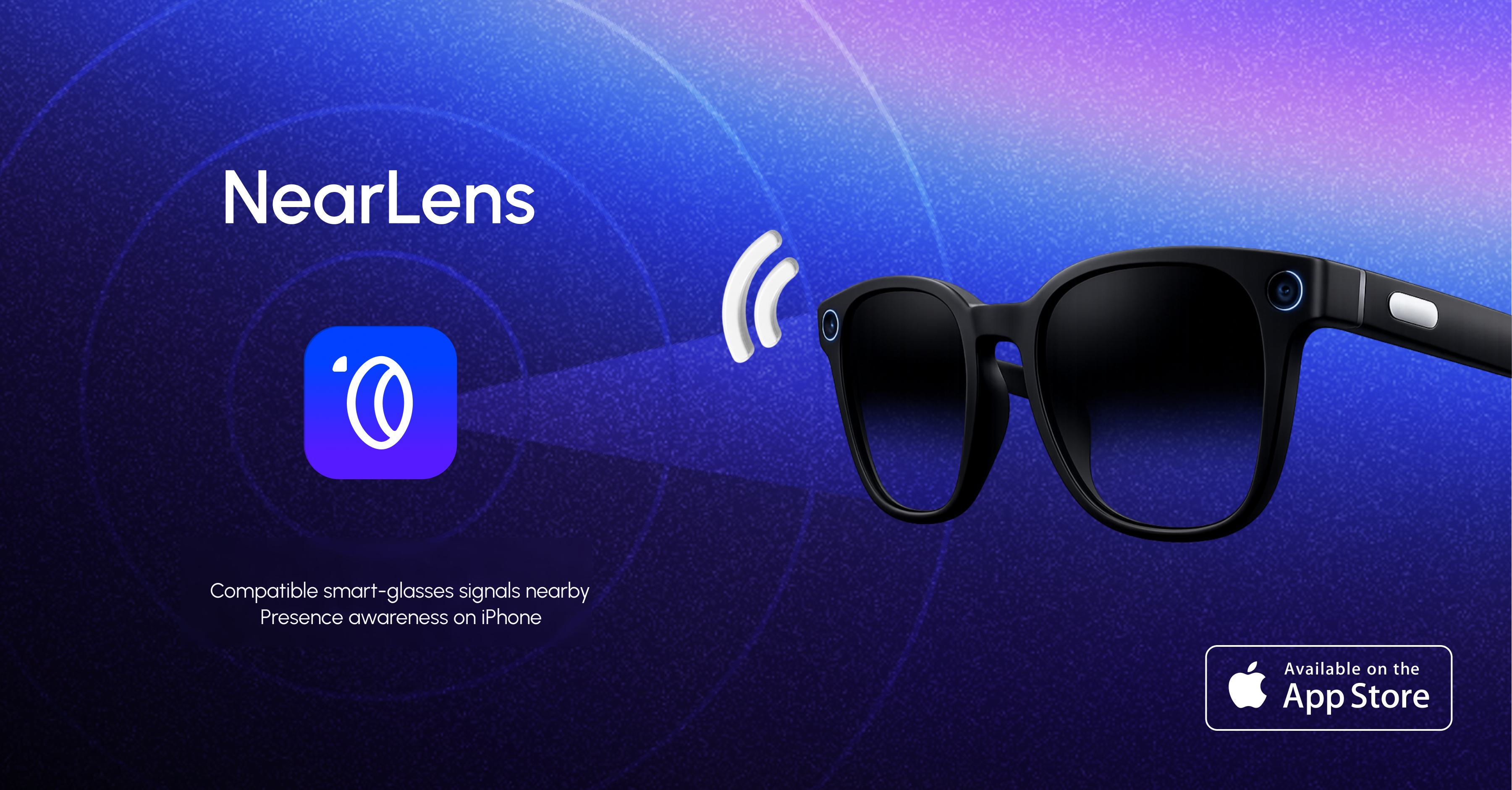
NearLens does not close the gap between what smart glasses can do and what a bystander can tell. It makes that gap visible instead.
The staged London illustration in this article did not happen. No consumer glasses on sale today draw a box around a stranger's face on a crowded street and retrieve a name.
That distinction matters because discussion of smart glasses often mixes current products, inactive code, patents and external demonstrations. Each describes a different level of technical readiness.
Documented development
What already exists, built and shelved
In January 2026, Meta shipped inactive code to its smart glasses for a facial-recognition feature internally called NameTag. The code was not available to users. Wired reported finding it in June, and Meta removed it within days of publication. An internal document obtained by The New York Times in February had described a possible launch plan and its timing.
Before that reporting, the ACLU and 75 other organisations sent Meta a letter opposing real-time facial recognition on smart glasses. In August, 404 Media reported that Meta had filed a patent for a related feature designed to identify guests at a gathering and assemble person-specific highlight reels.
These records cover code that was written, a planning document that was reported and a patent that was filed. They show development activity without establishing that any of those features reached consumers.
A separate 2024 demonstration by two Harvard students combined Meta smart glasses with the commercial face-search service PimEyes and public records. The system returned names and other personal details about strangers during live interactions. Meta stated that its glasses contained no facial-recognition technology and that the demonstration combined publicly available software with a camera that could have been any camera. The demonstration nevertheless showed how wearable capture can act as an input to an external identification system.

External notice
What remains between a bystander and that capability
Every pair of Ray-Ban Meta glasses includes a small white LED that illuminates during recording. The light can be difficult to notice in ambient conditions even when it works as designed, and at least one documented physical modification has removed it while leaving recording available.
The capability shown in the illustration is therefore neither a standard consumer feature nor science fiction. Its separate components have been built or demonstrated, while a public consumer implementation remains unlaunched. For a bystander, the visible safeguard is still a small light on a device designed to resemble ordinary eyewear.
NearLens and the visibility gap
A Bluetooth scanner, not a face scanner
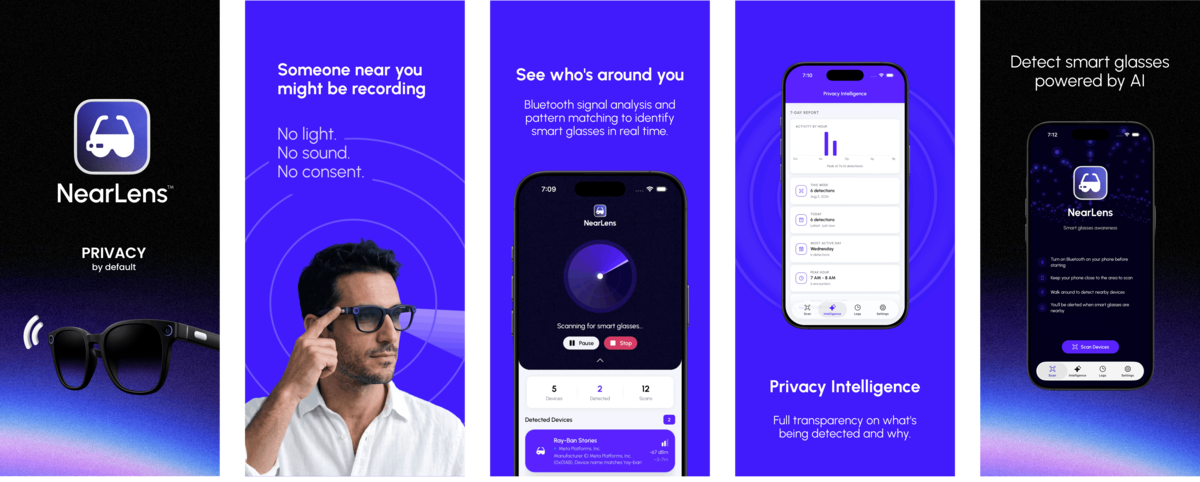
NearLens listens for advertising packets that Bluetooth devices broadcast openly and compares them with recognition data associated with known smart-glasses hardware. Nothing is paired, intercepted or decrypted. The wearer is not contacted or notified.
The app is not a universal detector. A nearby device may produce no result if it does not broadcast or uses an identifier that NearLens does not recognise. A result indicates likely device presence only. It does not reveal a name, capture a photo, identify a wearer or confirm that recording is active.
NearLens has no account, analytics, telemetry or crash-reporting service. Detection history is optional and remains on the device. The exact automatic-clearing interval in the current release has not been verified, so NearLens does not promise a fixed retention period here. iOS does not require location authorisation for Core Bluetooth scanning, and NearLens does not need GPS coordinates for detection. The app works offline and has no paid tier.
During one field observation at a large arena, NearLens flagged 15 signals likely associated with smart glasses, with no confirmed false positives. At a theatre, it observed 823 Bluetooth devices and returned no smart-glasses matches. These observations show specific test results, not a prevalence estimate.
Limits of an alert
What an alert does not establish
An alert is not proof that anyone is recording and does not identify who may be wearing the device or what they intend. It provides a limited signal that can inform an individual choice, such as changing seats, moving a sensitive conversation, asking a venue about its policy or taking no action.
Why NearLens exists
A signal where none was previously available
NearLens does not claim to solve bystander privacy. Its focus is the absence of an independent signal that recording-capable eyewear may be nearby. A raised phone is socially recognisable; glasses remove much of that visible posture.
Hardware-level consent and clearer bystander notice would address the issue closer to its source. NearLens provides something narrower: a private indication of likely device presence without identifying, tracking or reporting the person wearing it.
About
About NearLens
NearLens is a free iOS bystander-awareness tool developed in Ottawa, Canada. The app uses on-device Bluetooth Low Energy analysis to identify signals associated with camera-equipped smart glasses and does not collect personal data through the app. The website has separate, consent-controlled processing described in the Privacy Policy. NearLens is available on the App Store and at nearlens.app.
Share
If this story matters to you, pass it on.